Escalation & Mobilization
- Portfolio Risk Identified
- Operational Task Force Deployed
- Vendor & Systems Evaluation
- Legal & Investor Coordination
- Data Preservation
How Vervent mobilized in days to assume servicing for approximately 100,000 subprime auto loans following a Chapter 7 bankruptcy and allegations of widespread fraud.
When Tricolor Holdings and multiple affiliates collapsed into Chapter 7 bankruptcy in Irving, Texas, in September 2025 following allegations of fraud, approximately 100,000 borrowers were left without a servicer overnight. There was no reorganization effort. No operational handoff. No transition period. Access to Tricolor’s offices was prohibited by the Department of Justice as part of an active investigation. Tricolor employees were terminated, systems were inaccessible, vendors left unpaid, and borrowers were unable to reach anyone about their loans.
Speed was critical to maintain continuity to the portfolio of auto loans.
As the contractually designated backup servicer for a majority of the Tricolor portfolio, Vervent deployed an operational task force to Tricolor’s Texas headquarters within 48 hours, just days before Tricolor laid off its remaining employees and filed for Chapter 7 bankruptcy on September 10. Vervent was activated by the warehouse lender to assume successor servicing responsibilities and approved to perform services through a bankruptcy court ruling on September 19, 2025. Within eight business days of the bankruptcy filing and just one business day after receiving court authorization to act as successor servicer, Vervent was operating inside Tricolor’s legacy servicing system. Within 14 business days, loans were boarding into Vervent’s own system of record. Borrowers’ ability to make payments were never impacted, thus ensuring a keystone component in preserving the continuity of the portfolio and ensuring consumer access.
This engagement required far more than a standard servicing transition. Vervent deployed enterprise-wide expertise across operations, legal coordination, technology, crisis communications, bilingual recruiting, collateral management, and asset resolution, all while operating under court supervision in a highly publicized collapse with allegations of fraud.
When Tricolor Holdings and multiple affiliates collapsed into Chapter 7 bankruptcy in Irving, Texas, in September 2025 following allegations of fraud, approximately 100,000 borrowers were left without a servicer overnight. There was no reorganization effort. No operational handoff. No transition period. Access to Tricolor’s offices was prohibited by the Department of Justice as part of an active investigation. Tricolor employees were terminated, systems were inaccessible, vendors left unpaid, and borrowers were unable to reach anyone about their loans. Speed was critical to maintain continuity to the portfolio of auto loans.
As the contractually designated backup servicer for a majority of the Tricolor portfolio, Vervent deployed an operational task force to Tricolor’s Texas headquarters within 48 hours, just days before Tricolor laid off its remaining employees and filed for Chapter 7 bankruptcy on September 10. Vervent was activated by the warehouse lender to assume successor servicing responsibilities and approved to perform services through a bankruptcy court ruling on September 19, 2025. Within eight business days of the bankruptcy filing and just one business day after receiving court authorization to act as successor servicer, Vervent was operating inside Tricolor’s legacy servicing system. Within 14 business days, loans were boarding into Vervent’s own system of record. Borrowers’ ability to make payments were never impacted, thus ensuring a keystone component in preserving the continuity of the portfolio and ensuring consumer access.
This engagement required far more than a standard servicing transition. Vervent deployed enterprise-wide expertise across operations, legal coordination, technology, crisis communications, bilingual recruiting, collateral management, and asset resolution, all while operating under court supervision in a highly publicized collapse with allegations of fraud.
This was not a typical servicer transition. Tricolor’s collapse created a set of compounding
challenges that went well beyond a standard successor servicing portfolio onboarding:
Vervent coordinated multiple workstreams across legal, servicing operations, vendor management, technology, data, communications, recruiting, collateral management, tax, and asset resolution. Each function had a distinct role, but Vervent’s extensive expertise enabled the team to identify key operational breakdowns early and execute in parallel to preserve borrower continuity, establish control, maximize value, and reduce disruption risk.
These parallel workstreams proved to be impactful and moved into a multi-phased solution that required immediate mobilization to servicing stabilization, operational control, and longer-term resolution.
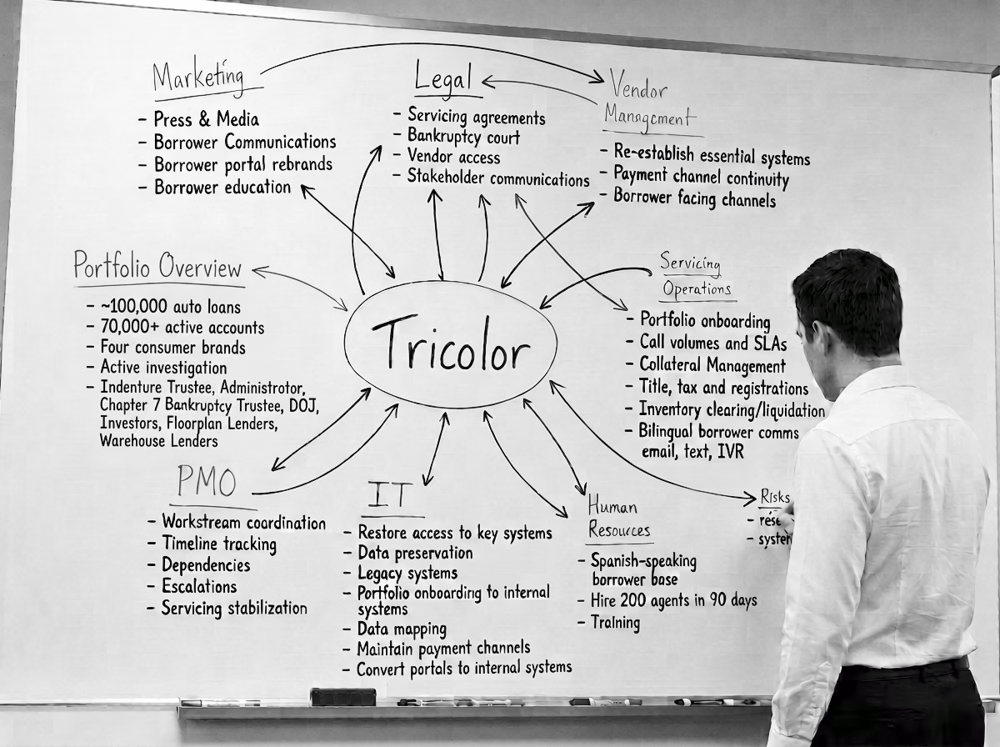

Internal and external legal counsel addressed court-supervised transition requirements, servicing authority, vendor access, reporting boundaries, stakeholder communications, and downstream transfer decisions.

Vendor management teams worked to re-establish critical operating relationships, restore access to essential systems and services, and preserve continuity across payment, communications, website, document, and borrower-facing channels through intensive vendor coordination and millions of dollars advanced by Vervent to maintain critical services.

PMO and servicing operations coordinated timelines, dependencies, escalation points, borrower-facing activity, call center readiness, and day-to-day servicing stabilization.

Technology, data, and systems teams worked to understand a fragmented operating environment, preserve records, restore access, map data, maintain payment and borrower-facing channels, and prepare for conversion into Vervent’s servicing systems and operational infrastructure.

Crisis communications and borrower education managed messaging across borrowers, investors, bondholders, rating agencies, media, vendors, and internal teams while maintaining alignment with legal and operational facts.

Recruiting and training scaled bilingual servicing capacity, retained key institutional knowledge, and prepared agents on portfolio-specific workflows, borrower messaging, escalation paths, and compliance requirements.

Collateral, title, tax, collateral protection insurance, and asset-resolution teams advanced document access, title and registration activity, insurance workflows, auction-related workstreams, and inventory clearing efforts that extended well beyond traditional successor servicing duties, including coordinating the sale of approximately 9,500 vehicles.

Vervent’s response leveraged 35+ years of primary and backup servicing experience across consumer, auto, RV, solar, equipment finance, credit card, and specialty finance asset classes. The transition unfolded across three distinct phases: immediate mobilization, operational stabilization, and long-term control.

What distinguished this engagement from a standard successor servicing activation was the scope of responsibilities assumed by Vervent, combined with the complete absence of transition support from the original servicer. The following activities extended well beyond traditional successor servicing expectations:
Through strategic execution and enterprise-wide operational depth, Vervent ensured the successful assumption of servicing responsibilities for the Tricolor portfolio and provided continuity for approximately 100,000 borrowers during one of the most complex servicing transitions in the subprime auto market in years.

Before and during COVID, the industry averaged one to two servicer transitions per year. Since then, the market has seen more than 20 separate backup servicing activations. Transition timelines have compressed from 45 days to 30 or fewer. Rating agencies, investors, and regulators are all paying closer attention to whether backup servicers can actually execute when called upon.
The Tricolor transition demonstrated that successor servicing capability is not defined by contractual designation alone. It depends on whether a servicer can mobilize people, systems, legal coordination, borrower communications, vendor relationships, and asset-level operations under stressed conditions.
The difference between a backup servicer designation and execution capability is operational depth, leadership experience, and asset class expertise. Vervent’s ability to operate as both a backup servicer and primary servicer across multiple asset classes enabled execution at this scale and speed.
The Tricolor transition was not a test of readiness. It was a test of execution. A chapter 7 bankruptcy, fraud allegations, 100,000 borrowers, four consumer brands, offices sealed by federal investigators, and a portfolio that could not afford a singleday without active servicing.
Backup servicers are only as strong as the primary servicing infrastructure behind them. The Tricolor collapse raised the standard and Vervent set the bar for trusted and proven operational execution.